

Publikationen
Diese Liste wird automatisch aus OpenAlex aktualisiert. Vollständige Profile gibt es außerdem bei ORCID, Google Scholar.
32 Publikationen
2026
MixMatchDet: Mixing and Matching Tokens for Plain ViT Detectors
Konferenz German Conference on Pattern Recognition (GCPR) 2026, accepted
BibTeX
@inproceedings{rohrschneider2026mixmatchdet,
  title = {MixMatchDet: Mixing and Matching Tokens for Plain ViT Detectors},
  author = {David Rohrschneider and Anselm Haselhoff and Uwe Handmann},
  year = {2026},
  booktitle = {German Conference on Pattern Recognition (GCPR) 2026, accepted}
}
Batch active learning for reliability-based model validation
Zeitschrift Reliability Engineering & System Safety, 2026
BibTeX
@article{lammle2026batch,
  title = {Batch active learning for reliability-based model validation},
  author = {Sven Lämmle and Julia Stecher and Thomas Hodrius and Anselm Haselhoff and Dirk Roos},
  year = {2026},
  journal = {Reliability Engineering & System Safety},
  pages = {112631--112631},
  doi = {10.1016/j.ress.2026.112631}
}

2024
Konferenz European Conference on Computer Vision (ECCV) 2024
BibTeX
@inproceedings{haselhoff2024the,
  title = {The Gaussian Discriminant Variational Autoencoder (GdVAE): A Self-explainable Model with Counterfactual Explanations},
  author = {Anselm Haselhoff and Kevin Trelenberg and Fabian Küppers and Jonas Schneider},
  year = {2024},
  booktitle = {European Conference on Computer Vision (ECCV) 2024},
  pages = {305--322},
  doi = {10.1007/978-3-031-73668-1_18},
  eprint = {2409.12952},
  archivePrefix = {arXiv}
}
Quantifying Local Model Validity using Active Learning
Konferenz Conference on Uncertainty in Artificial Intelligence (UAI) 2024
Abstract
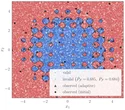
Real-world applications of machine learning models are often subject to legal or policy-based regulations. Some of these regulations require ensuring the validity of the model, i.e., the approximation error being smaller than a threshold. A global metric is generally too insensitive to determine the validity of a specific prediction, whereas evaluating local validity is costly since it requires gathering additional data.We propose learning the model error to acquire a local validity estimate while reducing the amount of required data through active learning. Using model validation benchmarks, we provide empirical evidence that the proposed method can lead to an error model with sufficient discriminative properties using a relatively small amount of data. Furthermore, an increased sensitivity to local changes of the validity bounds compared to alternative approaches is demonstrated.
BibTeX
@inproceedings{lammle2024quantifying,
  title = {Quantifying Local Model Validity using Active Learning},
  author = {Sven Lämmle and Can Bogoclu and Robert Voßhall and Anselm Haselhoff and Dirk Roos},
  year = {2024},
  booktitle = {Conference on Uncertainty in Artificial Intelligence (UAI) 2024},
  eprint = {2406.07474},
  archivePrefix = {arXiv}
}

2023
Parametric and Multivariate Uncertainty Calibration for Regression and Object Detection
Konferenz ECCV 2022 Workshops, 2023
BibTeX
@inproceedings{kuppers2023parametric,
  title = {Parametric and Multivariate Uncertainty Calibration for Regression and Object Detection},
  author = {Fabian Küppers and Jonas Schneider and Anselm Haselhoff},
  year = {2023},
  booktitle = {ECCV 2022 Workshops},
  pages = {426--442},
  doi = {10.1007/978-3-031-25072-9_30},
  eprint = {2207.01242},
  archivePrefix = {arXiv}
}
Uncertainty Calibration and its Application to Object Detection
Dissertation (betreut) University of Wuppertal, 2023
BibTeX
@phdthesis{kuppers2023uncertainty,
  title = {Uncertainty Calibration and its Application to Object Detection},
  author = {Fabian Küppers},
  year = {2023},
  booktitle = {University of Wuppertal},
  eprint = {2302.02622},
  archivePrefix = {arXiv}
}


2022
Segmentation-guided Domain Adaptation for Efficient Depth Completion
Preprint arXiv, 2022
Abstract
Complete depth information and efficient estimators have become vital ingredients in scene understanding for automated driving tasks. A major problem for LiDAR-based depth completion is the inefficient utilization of convolutions due to the lack of coherent information as provided by the sparse nature of uncorrelated LiDAR point clouds, which often leads to complex and resource-demanding networks. The problem is reinforced by the expensive aquisition of depth data for supervised training. In this work, we propose an efficient depth completion model based on a vgg05-like CNN architecture and propose a semi-supervised domain adaptation approach to transfer knowledge from synthetic to real world data to improve data-efficiency and reduce the need for a large database. In order to boost spatial coherence, we guide the learning process using segmentations as additional source of information. The efficiency and accuracy of our approach is evaluated on the KITTI dataset. Our approach improves on previous efficient and low parameter state of the art approaches while having a noticeably lower computational footprint.
BibTeX
@misc{markert2022segmentationguided,
  title = {Segmentation-guided Domain Adaptation for Efficient Depth Completion},
  author = {Fabian Märkert and Martin Sunkel and Anselm Haselhoff and Stefan Rudolph},
  year = {2022},
  howpublished = {arXiv},
  eprint = {2210.09213},
  archivePrefix = {arXiv}
}
Inspect, Understand, Overcome: A Survey of Practical Methods for AI Safety
Buchkapitel Deep Neural Networks and Data for Automated Driving, Springer, 2022
Abstract
Deployment of modern data-driven machine learning methods, most often realized by deep neural networks (DNNs), in safety-critical applications such as health care, industrial plant control, or autonomous driving is highly challenging due to numerous model-inherent shortcomings. These shortcomings are diverse and range from a lack of generalization over insufficient interpretability and implausible predictions to directed attacks by means of malicious inputs. Cyber-physical systems employing DNNs are therefore likely to suffer from so-called safety concerns, properties that preclude their deployment as no argument or experimental setup can help to assess the remaining risk. In recent years, an abundance of state-of-the-art techniques aiming to address these safety concerns has emerged. This chapter provides a structured and broad overview of them. We first identify categories of insufficiencies to then describe research activities aiming at their detection, quantification, or mitigation. Our work addresses machine learning experts and safety engineers alike: The former ones might profit from the broad range of machine learning topics covered and discussions on limitations of recent methods. The latter ones might gain insights into the specifics of modern machine learning methods. We hope that this contribution fuels discussions on desiderata for machine learning systems and strategies on how to help to advance existing approaches accordingly.
BibTeX
@incollection{houben2022inspect,
  title = {Inspect, Understand, Overcome: A Survey of Practical Methods for AI Safety},
  author = {Sebastian Houben and Stephanie Abrecht and Maram Akila and Andreas Bär and Felix Brockherde and Patrick Feifel and Tim Fingscheidt and Sujan Sai Gannamaneni and Seyed Eghbal Ghobadi and Ahmed Hammam and Anselm Haselhoff and Felix Hauser and Christian Heinzemann and Marco Hoffmann and Nikhil Kapoor and Falk Kappel and Marvin Klingner and Jan Kronenberger and Fabian Küppers and Jonas Löhdefink and Michael Mlynarski and Michael Möck and Firas Mualla and Svetlana Pavlitskaya and Maximilian Poretschkin and Alexander Pohl and Varun Ravi-Kumar and Julia Rosenzweig and Matthias Rottmann and Stefan Rüping and Timo Sämann and Jan David Schneider and Elena Haedecke and Gesina Schwalbe and Joachim Sicking and Toshika Srivastava and Serin Varghese and Michael Weber and Sebastian Wirkert and Tim Wirtz and Matthias Woehrle},
  year = {2022},
  booktitle = {Deep Neural Networks and Data for Automated Driving, Springer},
  pages = {3--78},
  doi = {10.1007/978-3-031-01233-4_1},
  eprint = {2104.14235},
  archivePrefix = {arXiv}
}
Confidence Calibration for Object Detection and Segmentation
Buchkapitel Deep Neural Networks and Data for Automated Driving, Springer, 2022
Abstract
Calibrated confidence estimates obtained from neural networks are crucial, particularly for safety-critical applications such as autonomous driving or medical image diagnosis. However, although the task of confidence calibration has been investigated on classification problems, thorough investigations on object detection and segmentation problems are still missing. Therefore, we focus on the investigation of confidence calibration for object detection and segmentation models in this chapter. We introduce the concept of multivariate confidence calibration that is an extension of well-known calibration methods to the task of object detection and segmentation. This allows for an extended confidence calibration that is also aware of additional features such as bounding box/pixel position and shape information. Furthermore, we extend the expected calibration error (ECE) to measure miscalibration of object detection and segmentation models. We examine several network architectures on MS COCO as well as on Cityscapes and show that especially object detection as well as instance segmentation models are intrinsically miscalibrated given the introduced definition of calibration. Using our proposed calibration methods, we have been able to improve calibration so that it also has a positive impact on the quality of segmentation masks as well.
BibTeX
@incollection{kuppers2022confidence,
  title = {Confidence Calibration for Object Detection and Segmentation},
  author = {Fabian Küppers and Anselm Haselhoff and Jan Kronenberger and Jonas Schneider},
  year = {2022},
  booktitle = {Deep Neural Networks and Data for Automated Driving, Springer},
  pages = {225--250},
  doi = {10.1007/978-3-031-01233-4_8},
  eprint = {2202.12785},
  archivePrefix = {arXiv}
}
Kalibrierung von Neuronalen Netzen für Detektionsmodelle
Buchkapitel VDI Verlag eBooks, 2022
BibTeX
@incollection{kuppers2022kalibrierung,
  title = {Kalibrierung von Neuronalen Netzen für Detektionsmodelle},
  author = {F. Küppers and Jan Kronenberger and Anselm Haselhoff and Jörg J. Schneider},
  year = {2022},
  booktitle = {VDI Verlag eBooks},
  pages = {49--62},
  doi = {10.51202/9783181023945-49}
}

2021
Bayesian Confidence Calibration for Epistemic Uncertainty Modelling
Konferenz IEEE Intelligent Vehicles Symposium, 2021
Abstract
Modern neural networks have found to be miscalibrated in terms of confidence calibration, i.e., their predicted confidence scores do not reflect the observed accuracy or precision. Recent work has introduced methods for post-hoc confidence calibration for classification as well as for object detection to address this issue. Especially in safety critical applications, it is crucial to obtain a reliable self-assessment of a model. But what if the calibration method itself is uncertain, e.g., due to an insufficient knowledge base? We introduce Bayesian confidence calibration - a framework to obtain calibrated confidence estimates in conjunction with an uncertainty of the calibration method. Commonly, Bayesian neural networks (BNN) are used to indicate a network's uncertainty about a certain prediction. BNNs are interpreted as neural networks that use distributions instead of weights for inference. We transfer this idea of using distributions to confidence calibration. For this purpose, we use stochastic variational inference to build a calibration mapping that outputs a probability distribution rather than a single calibrated estimate. Using this approach, we achieve state-of-the-art calibration performance for object detection calibration. Finally, we show that this additional type of uncertainty can be used as a sufficient criterion for covariate shift detection. All code is open source and available at https://github.com/EFS-OpenSource/calibration-framework.
BibTeX
@inproceedings{kuppers2021bayesian,
  title = {Bayesian Confidence Calibration for Epistemic Uncertainty Modelling},
  author = {Fabian Küppers and Jan Kronenberger and Jonas Schneider and Anselm Haselhoff},
  year = {2021},
  booktitle = {IEEE Intelligent Vehicles Symposium},
  pages = {466--472},
  doi = {10.1109/iv48863.2021.9575841},
  eprint = {2109.10092},
  archivePrefix = {arXiv}
}
Towards Black-Box Explainability with Gaussian Discriminant Knowledge Distillation
Konferenz CVPR 2021 Workshops
Abstract
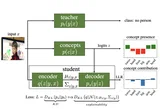
In this paper, we propose a method for post-hoc ex-plainability of black-box models. The key component of the semantic and quantitative local explanation is a knowledge distillation (KD) process which is used to mimic the teacher’s behavior by means of an explainable generative model. Therefore, we introduce a Concept Probability Density Encoder (CPDE) in conjunction with a Gaussian Discriminant Decoder (GDD) to describe the contribution of high-level concepts (e.g. object parts, color, shape). We argue that our objective function encourages both, an explanation given by a set of likelihood ratios and a measure to describe how far the explainer deviates from the training data distribution of the concepts. The method can leverage any pre-trained concept classifier that admits concept scores (e.g. logits) or probabilities. We demonstrate the effectiveness of the proposed method in the context of object detection utilizing the DensePose dataset.
BibTeX
@inproceedings{haselhoff2021towards,
  title = {Towards Black-Box Explainability with Gaussian Discriminant Knowledge Distillation},
  author = {Anselm Haselhoff and Jan Kronenberger and Fabian Küppers and Jonas Schneider},
  year = {2021},
  booktitle = {CVPR 2021 Workshops},
  pages = {21--28},
  doi = {10.1109/cvprw53098.2021.00011}
}
From Black-box to White-box: Examining Confidence Calibration under different Conditions
Preprint arXiv, 2021
Abstract
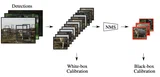
Confidence calibration is a major concern when applying artificial neural networks in safety-critical applications. Since most research in this area has focused on classification in the past, confidence calibration in the scope of object detection has gained more attention only recently. Based on previous work, we study the miscalibration of object detection models with respect to image location and box scale. Our main contribution is to additionally consider the impact of box selection methods like non-maximum suppression to calibration. We investigate the default intrinsic calibration of object detection models and how it is affected by these post-processing techniques. For this purpose, we distinguish between black-box calibration with non-maximum suppression and white-box calibration with raw network outputs. Our experiments reveal that post-processing highly affects confidence calibration. We show that non-maximum suppression has the potential to degrade initially well-calibrated predictions, leading to overconfident and thus miscalibrated models.
BibTeX
@misc{schwaiger2021from,
  title = {From Black-box to White-box: Examining Confidence Calibration under different Conditions},
  author = {Franziska Schwaiger and Maximilian Henne and Fabian Küppers and Felippe Schmoeller Roza and Karsten Roscher and Anselm Haselhoff},
  year = {2021},
  howpublished = {arXiv},
  doi = {10.24406/publica-fhg-410557},
  eprint = {2101.02971},
  archivePrefix = {arXiv}
}
2020
Dependency Decomposition and a Reject Option for Explainable Models
Preprint arXiv, 2020
Abstract
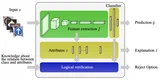
Deploying machine learning models in safety-related do-mains (e.g. autonomous driving, medical diagnosis) demands for approaches that are explainable, robust against adversarial attacks and aware of the model uncertainty. Recent deep learning models perform extremely well in various inference tasks, but the black-box nature of these approaches leads to a weakness regarding the three requirements mentioned above. Recent advances offer methods to visualize features, describe attribution of the input (e.g.heatmaps), provide textual explanations or reduce dimensionality. However,are explanations for classification tasks dependent or are they independent of each other? For in-stance, is the shape of an object dependent on the color? What is the effect of using the predicted class for generating explanations and vice versa? In the context of explainable deep learning models, we present the first analysis of dependencies regarding the probability distribution over the desired image classification outputs and the explaining variables (e.g. attributes, texts, heatmaps). Therefore, we perform an Explanation Dependency Decomposition (EDD). We analyze the implications of the different dependencies and propose two ways of generating the explanation. Finally, we use the explanation to verify (accept or reject) the prediction
BibTeX
@misc{kronenberger2020dependency,
  title = {Dependency Decomposition and a Reject Option for Explainable Models},
  author = {Jan Kronenberger and Anselm Haselhoff},
  year = {2020},
  howpublished = {arXiv},
  eprint = {2012.06523},
  archivePrefix = {arXiv}
}
Multivariate Confidence Calibration for Object Detection
Konferenz CVPR 2020 Workshops (SAIAD)
Abstract
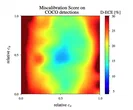
Unbiased confidence estimates of neural networks are crucial especially for safety-critical applications. Many methods have been developed to calibrate biased confidence estimates. Though there is a variety of methods for classification, the field of object detection has not been addressed yet. Therefore, we present a novel framework to measure and calibrate biased (or miscalibrated) confidence estimates of object detection methods1. The main difference to related work in the field of classifier calibration is that we also use additional information of the regression output of an object detector for calibration. Our approach allows, for the first time, to obtain calibrated confidence estimates with respect to image location and box scale. In addition, we propose a new measure to evaluate miscalibration of object detectors. Finally, we show that our developed methods outperform state-of-the-art calibration models for the task of object detection and provides reliable confidence estimates across different locations and scales.
BibTeX
@inproceedings{kuppers2020multivariate,
  title = {Multivariate Confidence Calibration for Object Detection},
  author = {Fabian Küppers and Jan Kronenberger and Amirhossein Shantia and Anselm Haselhoff},
  year = {2020},
  booktitle = {CVPR 2020 Workshops (SAIAD)},
  pages = {1322--1330},
  doi = {10.1109/cvprw50498.2020.00171},
  eprint = {2004.13546},
  archivePrefix = {arXiv}
}
2019
Random Forest on an Embedded Device for Real-time Machine State Classification
Konferenz European Signal Processing Conference (EUSIPCO), 2019
Abstract
Heavy machine tools are used in numerous industrial manufacturing processes. Avoiding unplanned maintenance time is crucial and can be achieved by continuous condition monitoring. A more targeted condition monitoring is possible if the operating state of a machine tool is known (e.g. standstill, neutral or cut). However, many manufacturers of control units do not release any information about the machine's operating state. For this reason, we investigated a system-independent approach to determine the operating state in real-time in less than 1 ms. This low runtime is necessary for machine state classification. Since most machine tools vary in individual components, the proposed state detection uses learning algorithms based on the machine's vibration characteristics. In this work we propose the Random Forest algorithm because of its reliable classification performance while keeping explainability of each prediction. Facing the real-time requirements, the Random Forest model has been adapted to an embedded device with very limited resources. Thus, the model prediction has to work with low resource consumption in a very low runtime and without loss in accuracy. We show that this approach is suitable for determining machine operating states in real-time in less than 700 μs with an average accuracy of 96 %.
BibTeX
@inproceedings{kuppers2019random,
  title = {Random Forest on an Embedded Device for Real-time Machine State Classification},
  author = {Fabian Küppers and Jonas Albers and Anselm Haselhoff},
  year = {2019},
  booktitle = {European Signal Processing Conference (EUSIPCO)},
  pages = {1--5},
  doi = {10.23919/eusipco.2019.8902993}
}
2018
Do Capsule Networks Solve the Problem of Rotation Invariance for Traffic Sign Classification?
Konferenz International Conference on Artificial Neural Networks (ICANN) 2018
BibTeX
@inproceedings{kronenberger2018do,
  title = {Do Capsule Networks Solve the Problem of Rotation Invariance for Traffic Sign Classification?},
  author = {Jan Kronenberger and Anselm Haselhoff},
  year = {2018},
  booktitle = {International Conference on Artificial Neural Networks (ICANN) 2018},
  pages = {33--40},
  doi = {10.1007/978-3-030-01424-7_4}
}
2017
Markov random field for image synthesis with an application to traffic sign recognition
Konferenz IEEE Intelligent Vehicles Symposium, 2017
Abstract
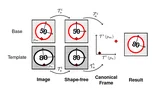
In current state-of-the-art systems for object detection and classification a huge amount of data is needed. Even if large databases are available, some classes are typically underrepresented and therefore the classifier is not able to capture the variability in appearance. In this work we present a novel method to enrich the training database with natural looking synthetic images. The method can be used to transfer the object appearance from one image (template image) to another image (base image) containing a different object of the same or a similar category. In order to preserve natural appearance and avoid artifacts we only use the gray-level values of the base image for synthesis. The main contribution of this work is an extension of the shift-map approach [1]. An appropriate optimization criteria for the used Markov Random Field (MRF) is defined and the MRF is embedded into a general framework for training data synthesis, which is exemplary tailored to the generation of traffic signs. The influence of using synthetic images is evaluated using a convolutional neural network (CNN).
BibTeX
@inproceedings{haselhoff2017markov,
  title = {Markov random field for image synthesis with an application to traffic sign recognition},
  author = {Anselm Haselhoff and Christian Nunn and Dennis Muller and Mirko Meuter and Lutz Roese-Koerner},
  year = {2017},
  booktitle = {IEEE Intelligent Vehicles Symposium},
  pages = {1407--1412},
  doi = {10.1109/ivs.2017.7995907}
}
2011
Multisensor data fusion for advanced driver assistance systems - the Active Safety Car project
Konferenz International Workshop on Multidimensional (nD) Systems (nDS), 2011
Abstract
Driver assistance systems support overstrained and affected drivers and become more and more essential for series-production vehicles. Object detection and segmentation is one of the most challenging research topics in this field. In order to warn the driver or automatically break before a potential collision, objects intersecting the path of the host vehicle have to be detected and classified. Most recently developed approaches are based on two dimensional image processing, sometimes in combination with a tracking algorithm associating detections in consecutive frames to one and the same object. Further robustness is achieved by multisensor data fusion, i.e. information by two or more different sensors (e.g. camera and radar data) are fused in order to get a much more reliable result. Another aspect for safety applications is communication between cars, which provides additional sensor locations and thus also requires data fusion technology. Two different approaches for data fusion are proposed and first results are presented.
BibTeX
@inproceedings{gavriilidis2011multisensor,
  title = {Multisensor data fusion for advanced driver assistance systems - the Active Safety Car project},
  author = {Alexandros Gavriilidis and Tim Schwerdtfeger and Jörg Velten and Sam Schauland and Lars Hoehmann and Anselm Haselhoff and Fritz Boschen and Anton Kummert},
  year = {2011},
  booktitle = {International Workshop on Multidimensional (nD) Systems (nDS)},
  pages = {1--5},
  doi = {10.1109/nds.2011.6076836}
}
On Occlusion-Handling for People Detection Fusion in Multi-camera Networks
Konferenz Communications in Computer and Information Science, Springer, 2011
BibTeX
@inproceedings{haselhoff2011on,
  title = {On Occlusion-Handling for People Detection Fusion in Multi-camera Networks},
  author = {Anselm Haselhoff and Lars Hoehmann and Christian Nunn and Mirko Meuter and Anton Kummert},
  year = {2011},
  booktitle = {Communications in Computer and Information Science, Springer},
  pages = {113--119},
  doi = {10.1007/978-3-642-21512-4_13}
}
Multi-camera Pedestrian Detection by Means of Track-to-track Fusion and Car2car Communication
Konferenz International Conference on Computer Vision Theory and Applications, 2011
Abstract
In this paper a system for fusion of pedestrian detections from multiple vehicles is presented. The application area is narrowed down to driver assistance systems, where single cameras are mounted in the moving vehicles. The main contribution of this paper is a comparison of three fusion algorithms based on real image data. The methods under review include Covariance Fusion, Covariance Intersection, and Covariance Union. An experimental setup is presented, with known ground truth positions of the detected objects. This information can be incorporated for the evaluation of the fusion methods. The system setup consists of two vehicles equipped with LANCOM® wireless access points, cameras, inertial measurement units (IMU) and IMU enhanced GPS receivers. Each vehicle detects pedestrians by means of the camera and an AdaBoost detection algorithm. The results are tracked and transmitted to the other vehicle in appropriate coordinates. Afterwards each vehicle is responsible for reasonable treatment or fusion of the detection data.
BibTeX
@inproceedings{haselhoff2011multicamera,
  title = {Multi-camera Pedestrian Detection by Means of Track-to-track Fusion and Car2car Communication},
  author = {Anselm Haselhoff and Lars Hoehmann and Anton Kummert and Christian Nunn and Mirko Meuter and Stefan Müller-Schneiders},
  year = {2011},
  booktitle = {International Conference on Computer Vision Theory and Applications},
  pages = {307--312},
  doi = {10.5220/0003315603070312}
}
2010
Pedestrian crossing detecting as a part of an urban pedestrian safety system
Konferenz IEEE Intelligent Vehicles Symposium, 2010
Abstract
Although recent statistics demonstrate a decrease in pedestrian fatalities, the absolute number of accident related deaths is sufficiently high to justify research in the area of vulnerable road user protection. Research has shown that situation awareness, which requires a significant amount of context information, is critical to timely intervention. Altered pedestrian behavior, due to traffic regulation, requires context information. For example, crosswalk presence and location knowledge can be of importance in pedestrian crossing scenarios. Therefore this paper discusses the implementation of a crosswalk detection algorithm, using Fourier transformation, augmented bipolarity, inverse perspective mapping template matching and edge orientation ratios for classification.
BibTeX
@inproceedings{sichelschmidt2010pedestrian,
  title = {Pedestrian crossing detecting as a part of an urban pedestrian safety system},
  author = {Sebastian Sichelschmidt and Anselm Haselhoff and Anton Kummert and Martin Roehder and Bjorn Elias and Karsten Berns},
  year = {2010},
  booktitle = {IEEE Intelligent Vehicles Symposium},
  pages = {840--844},
  doi = {10.1109/ivs.2010.5548032}
}
On visual crosswalk detection for driver assistance systems
Konferenz IEEE Intelligent Vehicles Symposium, 2010
Abstract
In this paper a new crosswalk detection strategy is presented. The application area is narrowed down to driver assistance systems to guarantee a reliable detection result and to benefit from the properties of a vehicle mounted camera. The main contribution of this paper is an efficient method to detect line segments that are typical for road markings like lanes and crosswalks. Therefore an adaptive Haar-like filter is applied by means of an integral image, where the pass-band of the filter is adjusted according to the distance from the vehicle. The detected segments are then combined to regions of interest by means of prior knowledge of crosswalk dimensions. These regions are then passed to a simple classifying module that utilizes a set of moment invariants for classification. The final detection result is then tracked by a standard Kalman filter.
BibTeX
@inproceedings{haselhoff2010on,
  title = {On visual crosswalk detection for driver assistance systems},
  author = {Anselm Haselhoff and Anton Kummert},
  year = {2010},
  booktitle = {IEEE Intelligent Vehicles Symposium},
  pages = {883--888},
  doi = {10.1109/ivs.2010.5548074}
}
On filtering by means of generalized integral images: a review and applications
Zeitschrift Multidimensional Systems and Signal Processing, 2010
BibTeX
@article{haselhoff2010on,
  title = {On filtering by means of generalized integral images: a review and applications},
  author = {Anselm Haselhoff and Anton Kummert},
  year = {2010},
  journal = {Multidimensional Systems and Signal Processing},
  pages = {291--312},
  doi = {10.1007/s11045-010-0112-5}
}
2009
An evolutionary optimized vehicle tracker in collaboration with a detection system
Konferenz IEEE International Conference on Intelligent Transportation Systems (ITSC), 2009
Abstract
In this work a learning algorithm for visual object tracking is presented. As object representation a fast computable set of Haar-like features is used and a weighted correlation is applied for the matching process. The object tracker utilizes the same set of features that is already calculated for object detection and thus it is possible to reuse features for detection and tracking. The feature's weight values are optimized for the tracking purpose by means of evolutionary strategies. Different tests of the object tracker on real-world sequences are presented using vehicles as example objects. Additionally, an object detection system and the integration of the object tracker into that system is described. Besides the system is based on a cascade of boosted classifiers, Haar and Triangle features, an adaptive sliding window and finally a Kalman filter.
BibTeX
@inproceedings{haselhoff2009an,
  title = {An evolutionary optimized vehicle tracker in collaboration with a detection system},
  author = {Anselm Haselhoff and Anton Kummert},
  year = {2009},
  booktitle = {IEEE International Conference on Intelligent Transportation Systems (ITSC)},
  pages = {1--6},
  doi = {10.1109/itsc.2009.5309835}
}
A vehicle detection system based on Haar and Triangle features
Konferenz IEEE Intelligent Vehicles Symposium, 2009
Abstract
In recent years, the Viola and Jones rapid object detection approach became very popular. One aspect why this approach achieved acceptance is the numerical efficient computation of the Haar-like features on basis of the integral image. This efficiency is essential for sliding window techniques, where features have to be extracted for huge amounts of data. The main contribution of this paper is an efficient method to compute Triangle filters for feature extraction based on four integral images. The 2D Triangle filters are derived from 1D Bartlett functions. A comparison of Haar-like filters and the new Triangle filters is given by means of empirical results. The receiver operator characteristics reveal the superiority of the Triangle filters. Furthermore a vehicle detection system is described where the Triangle features are integrated. The system is based on a cascade of boosted classifiers, Haar and Triangle features, an adaptive sliding window and finally a Kalman filter.
BibTeX
@inproceedings{haselhoff2009a,
  title = {A vehicle detection system based on Haar and Triangle features},
  author = {Anselm Haselhoff and Anton Kummert},
  year = {2009},
  booktitle = {IEEE Intelligent Vehicles Symposium},
  pages = {261--266},
  doi = {10.1109/ivs.2009.5164288}
}
2D line filters for vision-based lane detection and tracking
Konferenz International Workshop on Multidimensional (nD) Systems (nDS), 2009
Abstract
In this work a vision-based lane detection system is presented. The main contribution is the application of 2D line filters for lane detection which suppress noise in the near distance without destroying lines in the fare distance. Line pairs are decided to belong to lane markings by means of parallelism is world coordinates and reasonable constraints concerning the road width. The polygon constructed from the detected lane markings is then tracked over time via a Kalman filter. Results of the approach are presented in terms of the detection accuracy on a labeled video sequence.
BibTeX
@inproceedings{haselhoff20092d,
  title = {2D line filters for vision-based lane detection and tracking},
  author = {Anselm Haselhoff and Anton Kummert},
  year = {2009},
  booktitle = {International Workshop on Multidimensional (nD) Systems (nDS)},
  doi = {10.1109/nds.2009.5196176}
}
An Analysis of Sampling for Filter-based Feature Extraction and Adaboost Learning
Konferenz International Conference on Computer Vision Theory and Applications, 2009
Abstract
In this work a sampling scheme for filter-based feature extraction in the field of appearance-based object detection is analyzed. Optimized sampling radically reduces the number of features during the AdaBoost training process and better classification performance is achieved. The signal energy is used to determine an appropriate sampling resolution which then is used to determine the positions at which the features are calculated. The advantage is that these positions are distributed according to the signal properties of the training images. The approach is verified using an AdaBoost algorithm with Haar-like features for vehicle detection. Tests of classifiers, trained with different resolutions and a sampling scheme, are performed and the results are presented.
BibTeX
@inproceedings{haselhoff2009an,
  title = {An Analysis of Sampling for Filter-based Feature Extraction and Adaboost Learning},
  author = {Anselm Haselhoff and Anton Kummert},
  year = {2009},
  booktitle = {International Conference on Computer Vision Theory and Applications},
  pages = {180--185},
  doi = {10.5220/0001791201800185}
}
2008
Determining an appropriate range of image resolutions for appearance-based object detection and Haar-like feature extraction
Konferenz International Symposium on Information Theory and its Applications, 2008
Abstract
This work outlines an approach to measure the influence of input pattern resolution on classification performance for appearance-based object detection algorithms. Signal theory is utilized to determine a reasonable pattern or image resolution before the time-consuming training process is considered. For this reason the energy for a given low resolution image is assessed with respect to the optimal case of high resolution. The approach is justified using an AdaBoost algorithm with Haar-like features in the context of vehicle detection. Furthermore, the transfer function of a Haar-like feature is examined in the context of the framework. Tests of classifiers, trained with different resolutions, are performed and the results are presented. These results reveal that a reasonable trade-off between computational load and classification performance can be made.
BibTeX
@inproceedings{haselhoff2008determining,
  title = {Determining an appropriate range of image resolutions for appearance-based object detection and Haar-like feature extraction},
  author = {Anselm Haselhoff and Anton Kummert},
  year = {2008},
  booktitle = {International Symposium on Information Theory and its Applications},
  pages = {1--5},
  doi = {10.1109/isita.2008.4895485}
}
A signal theoretic approach to measure the influence of image resolution for appearance-based vehicle detection
Konferenz IEEE Intelligent Vehicles Symposium, 2008
Abstract
In this work a framework to measure the influence of training image resolution on classification performance for appearance-based object detection algorithms is presented. It is shown that based on sampling theory a reasonable image resolution for feature extraction can be chosen in advance, that is prior to the time consuming feature extraction and testing of the classifier. This is possible due to measuring the signal energy that is preserved in a low resolution image with respect to the optimal case of a high resolution image. The approach is justified using an AdaBoost algorithm with Haar-like features for vehicle detection. Tests of classifiers, trained with different resolutions, are performed and the results are presented. These results reveal that there is a good tradeoff between classification performance and computational load. The presented framework helps choosing a resolution for a good description of the training data.
BibTeX
@inproceedings{haselhoff2008a,
  title = {A signal theoretic approach to measure the influence of image resolution for appearance-based vehicle detection},
  author = {Anselm Haselhoff and Sam Schauland and Anton Kummert},
  year = {2008},
  booktitle = {IEEE Intelligent Vehicles Symposium},
  pages = {822--827},
  doi = {10.1109/ivs.2008.4621252}
}
2007
Radar-Vision Fusion For Vehicle Detection By Means Of Improved Haar-Like Feature And Adaboost Approach
Konferenz Zenodo (CERN European Organization for Nuclear Research), 2007
Abstract
This work describes a vehicle detection system that uses fusion of vision and radar data. The radar provides a first estimation of the lateral position of vehicle candidates and the related distance information. This information is used to define a region of interest (ROI) that is subject to verification. A video camera is used for the verification purpose. The projection of the ROI onto the image plane is scanned via an AdaBoost object detection algorithm, and thus radar detection can be verified and more specific data of the vehicle's 3D position and width can be given. Moreover, the distance information provided by radar is used to choose optimal parameters during the visual detection process, e.g. properties of the scan window and parameters for fusing detections. In addition, mutual information for haar-like feature selection is used to increase detection rates.
BibTeX
@inproceedings{haselhoff2007radarvision,
  title = {Radar-Vision Fusion For Vehicle Detection By Means Of Improved Haar-Like Feature And Adaboost Approach},
  author = {Anselm Haselhoff and Anton Kummert and Schneider, Georg},
  year = {2007},
  booktitle = {Zenodo (CERN European Organization for Nuclear Research)},
  pages = {2070--2074},
  doi = {10.5281/zenodo.40629}
}
Radar-Vision Fusion with an Application to Car-Following using an Improved AdaBoost Detection Algorithm
Konferenz IEEE International Conference on Intelligent Transportation Systems (ITSC), 2007
Abstract
This work outlines an object detection system for usage within driver assistance systems. The system detects vehicles that are driving ahead of an equipped vehicle by means of vision and radar data fusion. The radar provides a first estimation of vehicle candidates with related lateral position and distance information. This information is used to define a region of interest (ROI) on an image obtained by a video camera. An AdaBoost object detection algorithm is utilized to scan the ROI and verify radar detection. Due to the visual detection more specific data of the vehicle's 3D position and width can be given. Moreover, the distance information provided by radar is used to choose optimal parameters during the visual detection process, e.g. properties of the scan window and parameters for fusing detections. In addition, this work will show that mutual information for haar-like feature selection can significantly increase detection rates using a new adaptive threshold.
BibTeX
@inproceedings{haselhoff2007radarvision,
  title = {Radar-Vision Fusion with an Application to Car-Following using an Improved AdaBoost Detection Algorithm},
  author = {Anselm Haselhoff and Anton Kummert and Georg Schneider},
  year = {2007},
  booktitle = {IEEE International Conference on Intelligent Transportation Systems (ITSC)},
  pages = {854--858},
  doi = {10.1109/itsc.2007.4357647}
}