
Reliability Engineering & System Safety, vol. 272 · 2026
Batch active learning for reliability-based model validation
Cite
@article{lammle2026batch,
  title = {Batch active learning for reliability-based model validation},
  author = {Sven Lämmle and Julia Stecher and Thomas Hodrius and Anselm Haselhoff and Dirk Roos},
  year = {2026},
  journal = {Reliability Engineering & System Safety},
  pages = {112631--112631},
  doi = {10.1016/j.ress.2026.112631}
}
In engineering, quantifying the deviation between model prediction and reality is crucial, particularly when simulation or empirical models are used in safety-critical applications or for product release. Model validation aims to quantify this discrepancy by comparing model predictions to experimental results. However, conducting physical experiments for validation is often costly and time-consuming. Active learning strategies can mitigate this problem by reducing the data needed to assess model accuracy. In practice, these strategies must account for experimental uncertainties, such as material variability.
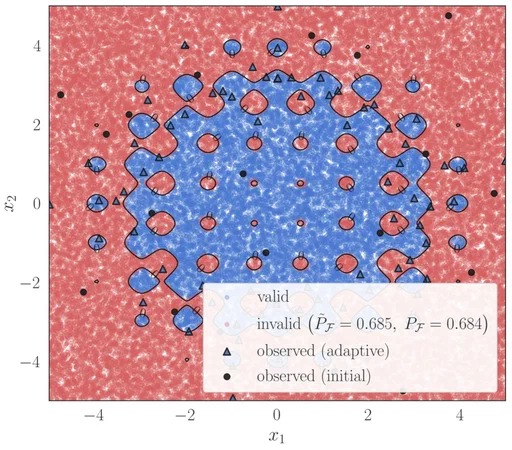
This work proposes an active learning framework for model validation focused on efficiently identifying the limit state between valid and invalid model regions under such conditions. Therefore, we introduce a decision-theoretical basis from which we derive two novel misclassification-based acquisition functions for mean-based and quantile-based validation. Furthermore, the framework is extended to the batch setting, allowing multiple points to be proposed for evaluation while considering nonlinear constraints of the input space. The proposed method is compared to alternative approaches for several analytical and engineering problems. Finally, the validation of a temperature model for an electric motor demonstrates the efficiency of the method in a complex scenario.
This work extends our UAI 2024 paper Quantifying Local Model Validity using Active Learning.